

Receiving triggers putaway
Inbound events create inventory records and assign putaway tasks in the same transaction.
PLATFORM ARCHITECTURE
Understand how Trenvar's architecture connects warehouse execution, transport, billing, and commerce through a shared event layer — not fragile point-to-point integrations.
Data Model
Event-Sourced
Isolation Model
Workspace-Sealed
Integration
API + Webhooks
Governance
Enterprise-Grade
Design Principles
These aren't implementation details — they're the reason Trenvar can connect warehouse floors to invoices, run multi-workspace operations safely, and pass enterprise audits without fragile middleware.
Every operational action — a scan, a dispatch, a charge — is an immutable event. Downstream systems (billing, audit, reporting) consume these events, not copies of mutable state.
Each workspace is a sealed boundary. Data, credentials, roles, and billing are scoped per workspace. No shared data paths exist between workspaces.
Each OS is a standalone execution layer. Stack them to create compound workflows — Warehouse + Transport, 3PL + Air Cargo — without re-platforming.
Thirteen workspace roles with per-permission grants — from company admin to driver to customer portal user. Every critical action is recorded as an immutable audit event with actor, timestamp, and entity. Compliance and access reviews use the same log your operations team already trusts.
Data flows from warehouse floor to invoice through events — not copy-paste, not CSV, not middleware.
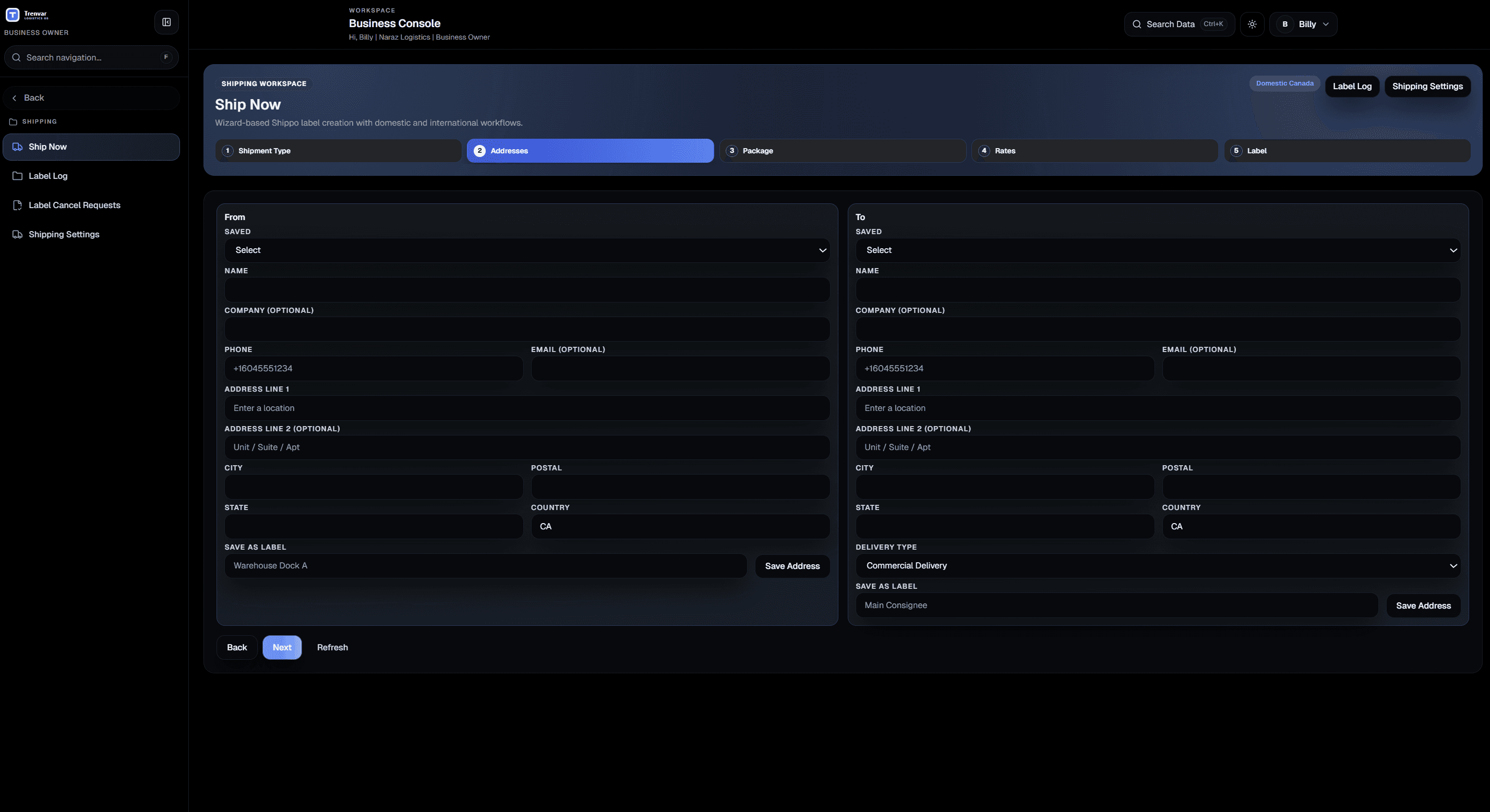
When a pallet is received, the event triggers putaway. When a shipment is packed, dispatch sees it. When storage accrues, billing captures it. One backbone connects everything.
One backbone connects every OS — floor to route to invoice.
No middleware, no manual sync, no data gaps between operational layers.
Warehouse + Transport
Warehouse OS captures inbound, manages inventory, and runs fulfillment. Transport OS picks up at dispatch — assigning drivers, tracking routes, and capturing POD. The connection is seamless because both layers consume the same event stream.
Inbound events create inventory records and assign putaway tasks in the same transaction.
Packed shipments surface in dispatch queues automatically — no manual handoff between warehouse and transport teams.
Proof-of-delivery events link back to the originating warehouse order, creating an unbroken chain of custody.
3PL + Air Cargo
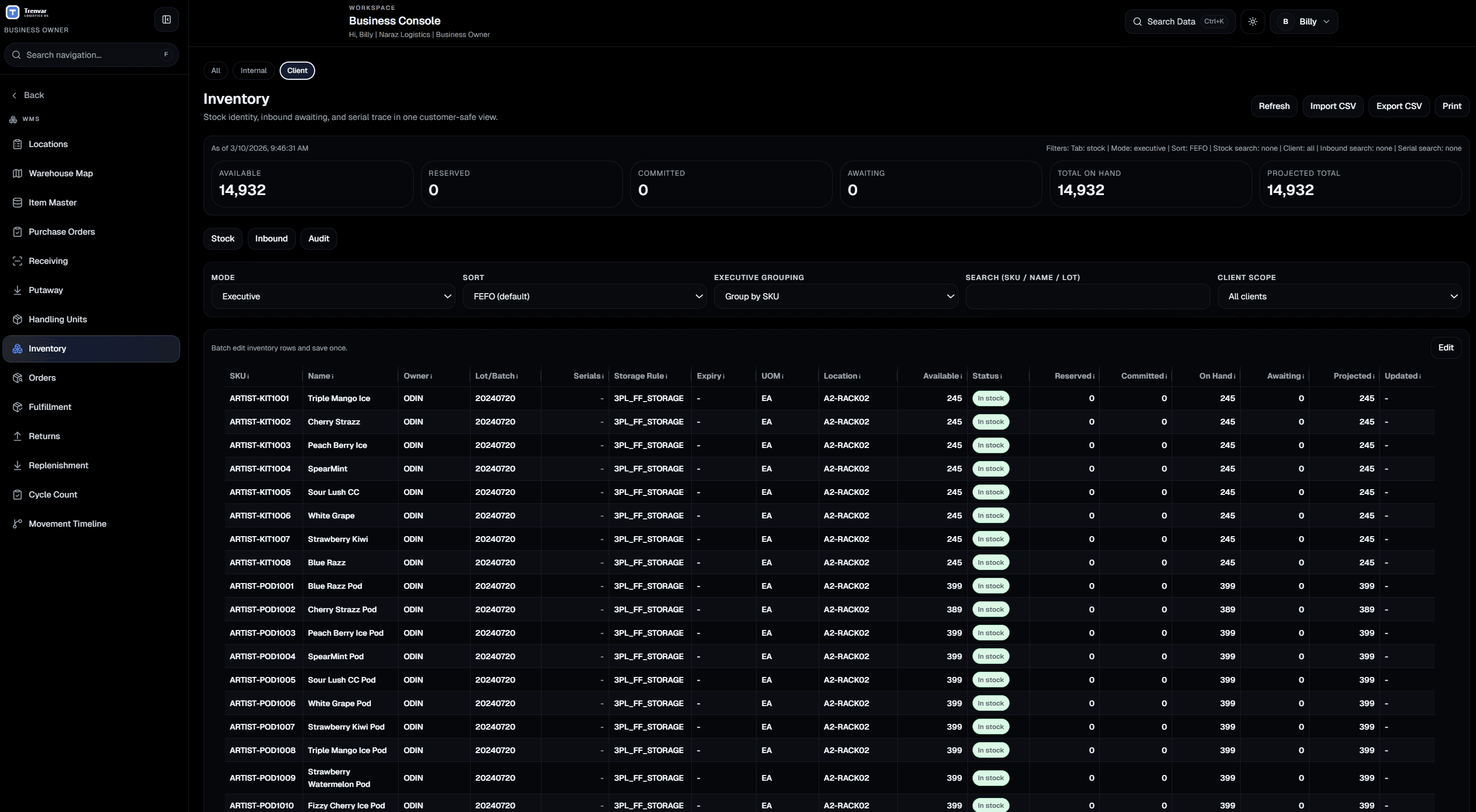
3PL OS manages customer-owned inventory with per-client isolation. Air Cargo OS extends this with AWB lifecycle tracking and ground handling milestones. Both feed into the same event-backed billing engine.
01
Each client's inventory, charges, and operational records are isolated — visible only to authorized roles.
02
Ground handling events (intake, storage, handoff) are logged as immutable milestones on a per-AWB timeline.
03
Storage accrual, service charges, and cargo handling fees are all generated from the same event backbone — no manual reconciliation.
Commerce + CRM
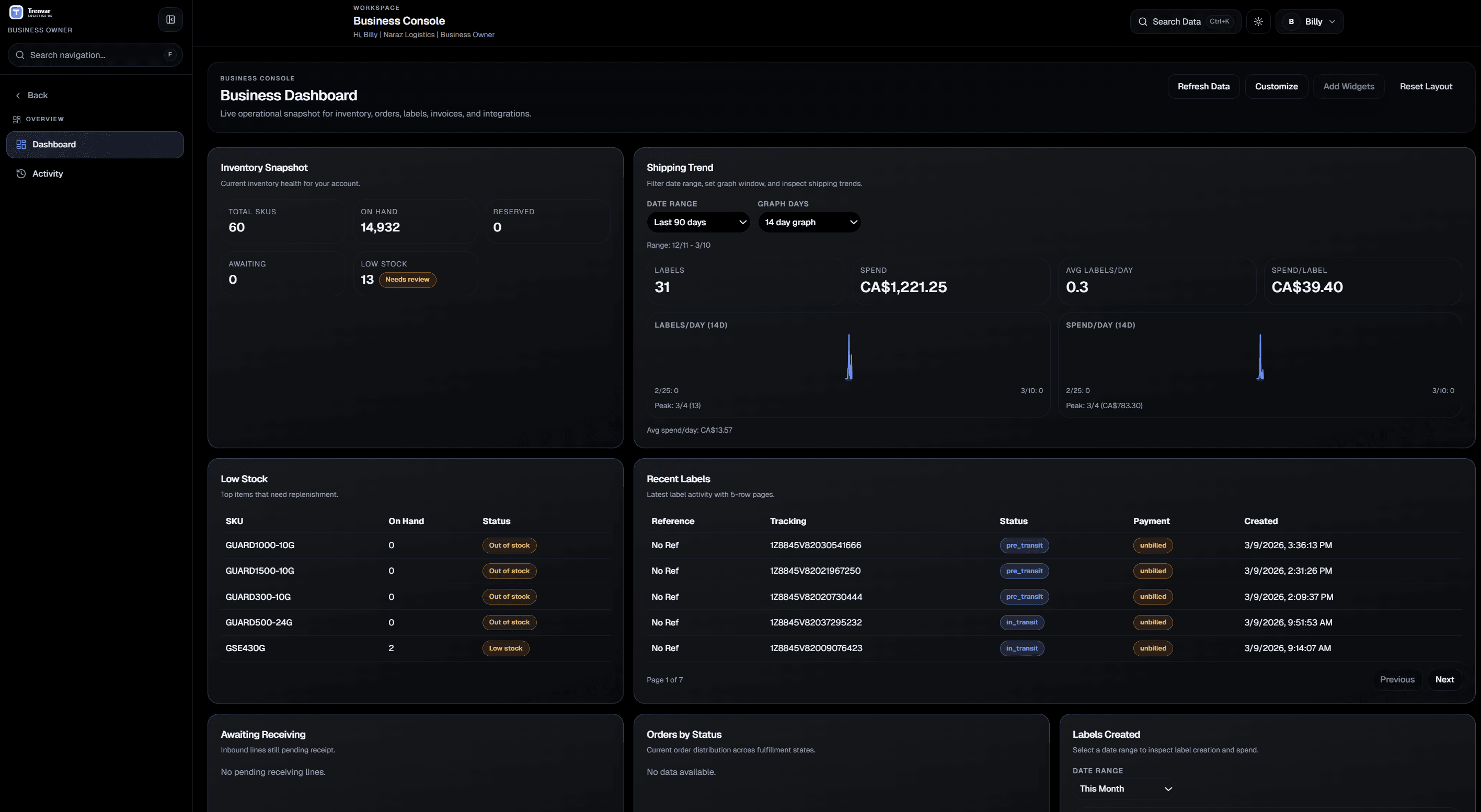
Sales CRM tracks accounts and opportunities. Commerce OS activates buyer profiles, catalogs, and ordering portals. When a deal closes, the buyer is already connected to your operational core.
Closed-won accounts in CRM create buyer profiles in Commerce OS — no manual re-entry or CSV import.
Activated buyers access product catalogs, place orders, and view invoice history through a controlled portal.
Buyer orders flow directly into warehouse fulfillment queues, maintaining traceability from commercial intent to physical execution.
OS Deep Dives
Each OS page covers capabilities, data model, role boundaries, and how it connects to the broader platform.
Warehouse OS
Inbound, inventory, putaway, and fulfillment execution.
Transport OS
Dispatch assignment, route tracking, and proof-of-delivery.
3PL OS
Multi-client warehouse operations with event-backed billing.
Air Cargo OS
Ground handling, AWB lifecycle, and cargo milestone tracking.
Customs OS
CBSA entry prep, classification, screening, and EDI-ready clearance. Runs standalone or as an add-on.
E-Invoicing
EN 16931 / PEPPOL BIS-compliant e-invoices with conformant UBL and network or clearance submission.
Commerce OS
Buyer profiles, catalogs, ordering portals, and invoice visibility.
Sales CRM
Account pipeline, opportunity tracking, and activation handoff.
Collaboration
Team messaging, customer-to-team chat, channels, threads, and reactions.
Integrations
API credentials, webhooks, delivery logs, and sync governance.
We'll walk through how your current systems map into Trenvar's event backbone and OS layers — with a phased rollout plan.
No credit card required · Go live in under 48 hours