
Guide — WMS Software Comparison

How to evaluate cloud warehouse management systems

A practical buyer's framework for comparing WMS platforms. Six scoring dimensions, the questions that separate signal from sales pitch, and the common evaluation pitfalls that cost teams months of wrong-fit pain.

  • 100-point framework
  • Six scoring dimensions
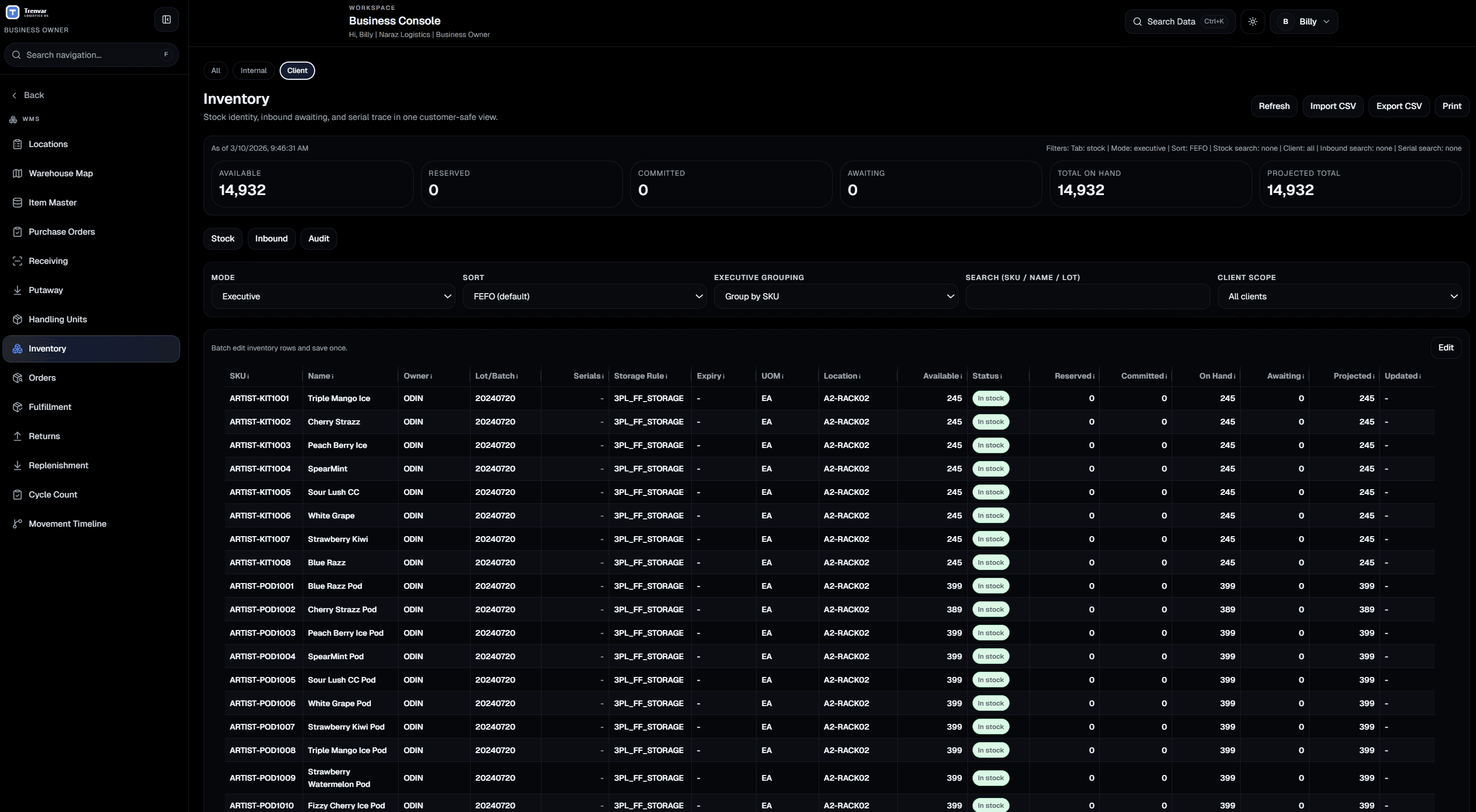
Product preview
WMS Comparison Framework
Live

The right WMS depends on operational fit — not feature count, demo polish, or sales-rep confidence.

This guide gives you the framework to score WMS platforms on what actually matters. Six dimensions, weighted by impact. Use it on your own shortlist.

Scoring framework

Six dimensions, weighted by impact

Each dimension carries a different weight depending on how much it affects buyer outcomes. Total: 100 points.

Architecture & data model

20 pts

How is the WMS structured under the hood? Is it a single coherent platform or modules from multiple acquisitions stitched together?

Questions to ask

  • Is the WMS, billing, and TMS on one codebase or separate products?
  • How does multi-tenant data separation work?
  • What is the upgrade cadence — monthly platform updates or major releases?

Red flags

  • Separate logins for warehouse, billing, and transport
  • Vague answers about how customer data is isolated
  • Long gap between major versions with patchy intermediate releases

Operational fit for your workflows

25 pts

Can the WMS execute your most-used workflows without configuration heroics? Run your top three workflows through the demo.

Questions to ask

  • Walk through receiving for our typical inbound pallet count.
  • Show pick-pack-ship for our highest-volume client SKU pattern.
  • What does cycle counting look like for our facility size?

Red flags

  • Demo skips your specific workflow in favor of vendor's preferred path
  • Multiple feature toggles required to enable basic operations
  • Workflows that look right in slides but require third-party tools in practice

Billing model

15 pts

How does the vendor charge, and how does it scale with your business? Per-client uplift punishes growth; module-based scales cleanly.

Questions to ask

  • How does pricing change as I add clients?
  • Are there per-user, per-warehouse, or per-transaction fees?
  • What does an enterprise contract look like for 50+ clients?

Red flags

  • Pricing depends entirely on the negotiated contract
  • Discounts only available with multi-year commitments
  • Per-client fees that compound as you grow

Integration depth

15 pts

Does the integration catalog cover your channel mix? Marketplace breadth varies dramatically across vendors.

Questions to ask

  • List every active channel I use today — which are supported natively?
  • How are unsupported channels typically handled — custom integration or out of scope?
  • What is the depth of the QuickBooks (or NetSuite, or your accounting tool) integration?

Red flags

  • "We support that channel" without specifics on sync depth
  • Custom integrations quoted at "engineering hourly rates"
  • Long list of integrations but no detail on data flow direction

Onboarding realism

15 pts

What does going live actually take? Vendor-stated timelines are often optimistic; reference customers are the ground truth.

Questions to ask

  • What does standard onboarding look like for a 3PL of my size?
  • Can I talk to two reference customers with similar operation shape?
  • What surprises do new customers typically encounter in the first 60 days?

Red flags

  • Onboarding presented as "flexible" with no concrete timeline
  • No willingness to provide reference customers
  • Implementation requires a separate professional-services contract

Support + roadmap

10 pts

What happens when you have a critical issue at 2am? What is on the product roadmap that affects your operation?

Questions to ask

  • What does support look like for production incidents?
  • What is on the 6-month product roadmap?
  • How does customer feedback shape priorities?

Red flags

  • Support only via ticket queue with multi-day response
  • Roadmap kept entirely private from customers
  • Roadmap items dating back multiple years with no shipping cadence

Common pitfalls

Mistakes that cost teams months of wrong-fit pain

The evaluation patterns that consistently lead to bad outcomes. Watch for these in your own process.

Falling for the feature checkbox trap

Every WMS has 200+ features. Counting checkboxes tells you nothing about which features actually work well in your operation. Score on fit, not on totals.

Skipping the reference customer call

Reference customers are the single highest-signal data point in software evaluation. Insist on them. If a vendor won't provide two customers with similar operation shape, that itself is the answer.

Trusting demo-stated onboarding timelines

"Go live in 30 days" from a sales rep means "the platform can technically be configured in 30 days" — not "your team will be productive in 30 days." Ask references how long it actually took them.

Letting pricing be the first filter

The cheapest option that doesn't fit your operation is more expensive than the right-fit option. Fit first, pricing second.

Confusing flexibility with capability

"Highly configurable" often means "you'll need professional services for everything." Configurability is a cost, not always a benefit. Out-of-the-box fit beats configurable mismatch.

Apply the framework

Where Trenvar lands on the scoring

We use the same framework to evaluate ourselves. Here is an honest read.

Trenvar scores strongly on architecture (single unified codebase, 20/20), billing model (module-based, no per-client uplift, 14/15), and onboarding realism (published 48-hour go-live for standard config, 13/15). The areas we score lower than competitors: integration breadth (23 connectors vs CartRover's 300+, 11/15) and product maturity for enterprise edge cases (we are younger than Manhattan or Extensiv, 7/10 on support+roadmap).

Realistic total: ~80/100. We are an excellent fit for small-to-mid 3PLs serving common ecommerce and B2B channels. We are a weaker fit for enterprise operations with deep marketplace long-tail integration requirements or extensive customization needs.

Apply this framework to your shortlist

If Trenvar belongs on your shortlist, the fastest way to validate fit is a 30-minute call walking through your three most operationally-painful workflows.

No credit card required · Go live in under 48 hours