

Pillar Guide — Multi-Client Warehousing
The multi-client warehousing guide — how to run a modern 3PL
Running a multi-client warehouse is structurally different from running a single-organization warehouse. Inventory separation, customer-level controls, billing isolation, and the platform architecture that scales from 5 clients to 50 — without re-platforming.
- 7 supporting articles
- For 3PL operators
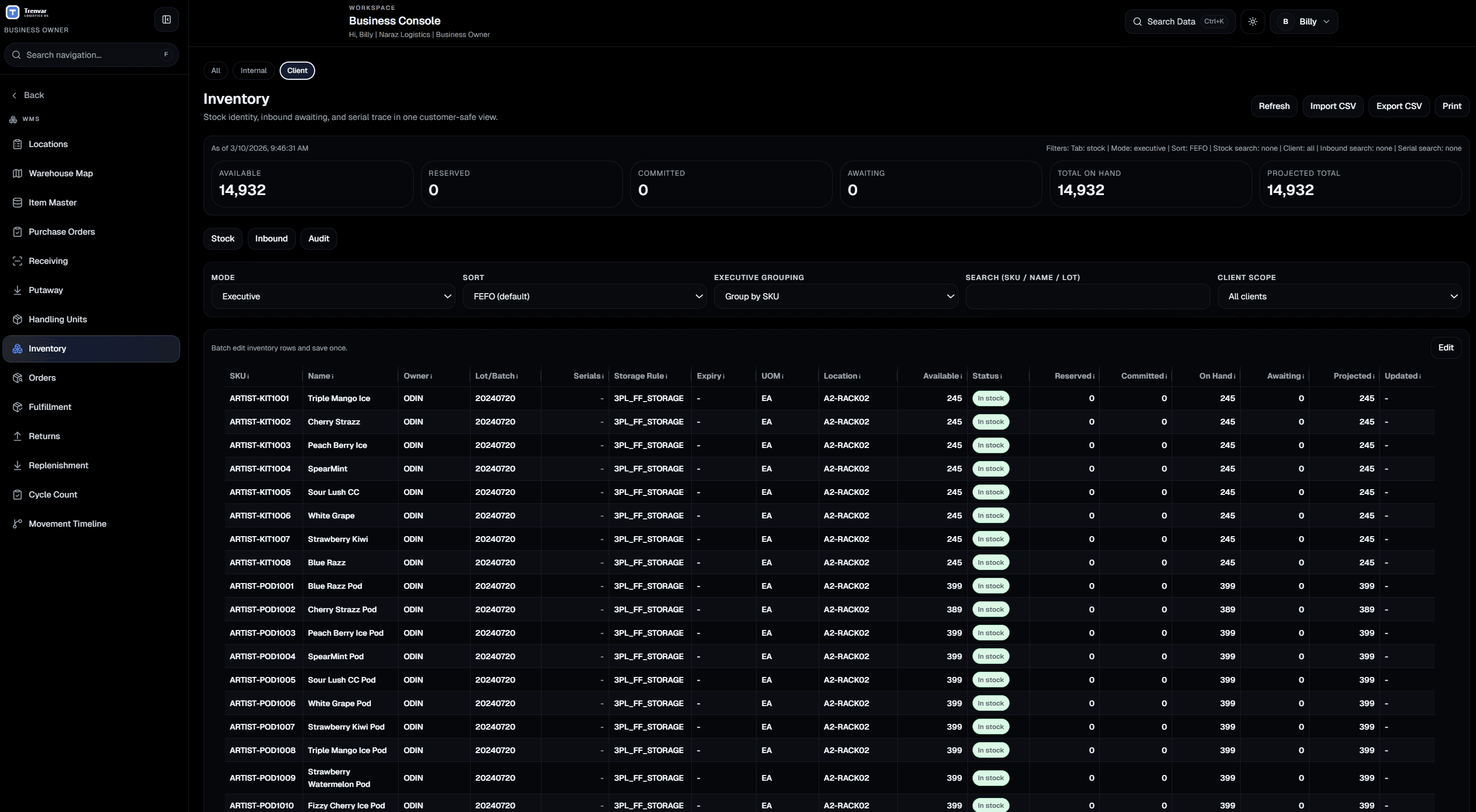
Multi-client warehousing is the operational shape of 3PL — and the structural choice that defines what kind of 3PL you become.
Every 3PL that grows past five clients faces the same set of platform decisions. Get them right and the next 45 clients onboard cleanly. Get them wrong and you re-platform under duress at 20 clients.
The fundamental shape
What makes multi-client warehousing different
Three structural differences from running a single-organization warehouse — and why each one matters for platform choice.
In a single-organization warehouse, every pallet on the floor belongs to one entity (your company). Storage, picking, and shipping are operational activities on your inventory. There is no concept of customer-level ownership, no per-customer rate cards, no inter-customer data boundaries.
In a multi-client warehouse, every pallet has an owner that is not you. You operate the building, the labor, and the systems — but the inventory is your customers'. Brand A's pallets sit next to Brand B's; both are billed separately, both have separate visibility into their own stock, both have separate operational expectations.
That single structural fact drives three platform requirements that don't exist in single-org operations: customer-level inventory separation at the data layer, per-customer billing infrastructure built from real operational events, and customer-facing visibility that exposes the right data to each client without leaking across the boundary.
Why platform choice matters
Three failure modes of single-org WMS applied to multi-client
Trying to run multi-client warehousing on a WMS designed for single-organization use produces predictable failures.
Inventory leakage
Without first-class customer ownership, inventory operations can accidentally cross client boundaries. A pick of Brand A inventory routed to a Brand B order. Stock counts that don't separate cleanly. Operational confusion that lands in customer disputes.
Billing impossibility
Single-org WMS produces operational data without customer-level attribution. Billing has to be back-fitted via spreadsheet logic. Charges drift from operational reality. Customer disputes accelerate as client count grows.
No customer portal path
Single-org WMS has no concept of giving Brand A visibility into Brand A's data without exposing Brand B. Customer-facing features become bolt-on integrations rather than first-class capabilities.
Decision points by client count
Where the operational and platform decisions sharpen
The thresholds at which 3PL operations need to make explicit structural choices.
Foundation
clientsAt this scale, anything works — spreadsheets, basic WMS, manual billing. The decisions you make here shape the next five years. Build for multi-tenant from day one even if you only have one client.
Operationalization
clientsThe point where ad-hoc approaches break. Customer-level inventory separation must be enforced by the platform. Billing must move from spreadsheet to system. Customer portal becomes a customer expectation.
Scaling
clientsOperations team can no longer manually maintain client-specific workflows. Standardized SOPs that work across clients become necessary. SLA tracking becomes commercially material.
Industrialization
clientsThe point where 3PL business mechanics matter more than warehouse mechanics. Client onboarding becomes a repeatable process. Margins are won and lost in operational efficiency and billing automation, not heroic operations.
Supporting articles
Seven deep-dives on running multi-client operations
Each article addresses a specific question 3PL operators face as they scale.
Multi-Client Inventory Separation
How multi-tenant WMS architecture enforces customer-level isolation.
5 min read
3PL Client Onboarding Checklist
What to set up before going live with a new 3PL customer.
7 min read
Customer Portal Setup
Role-safe visibility for clients into their inventory, orders, and invoices.
6 min read
3PL SLA Tracking
How to prove service levels per client in QBRs and contract renewals.
6 min read
Growing a 3PL Business
When to add clients and what platform capabilities prevent re-platforms.
7 min read
Shared vs Dedicated Warehouse Models
The structural choice between shared multi-tenant and dedicated facilities.
5 min read
Software for Small 3PLs
What features actually matter at small scale (and what's overkill).
6 min read
Map your multi-client operation to Trenvar
Bring your client list and operating model. We will walk through what running multi-client warehousing on Trenvar looks like — including customer portal access, billing isolation, and operational visibility.
No credit card required · Go live in under 48 hours