

Pillar Guide — 3PL Billing
The 3PL billing guide — how to bill multi-client warehousing right
A complete operational guide to 3PL billing — rate cards, storage accrual, handling charges, carrier reconciliation, and the automation patterns that replace month-end spreadsheets. Plus seven supporting articles on specific questions.
- 7 supporting articles
- Operator-focused
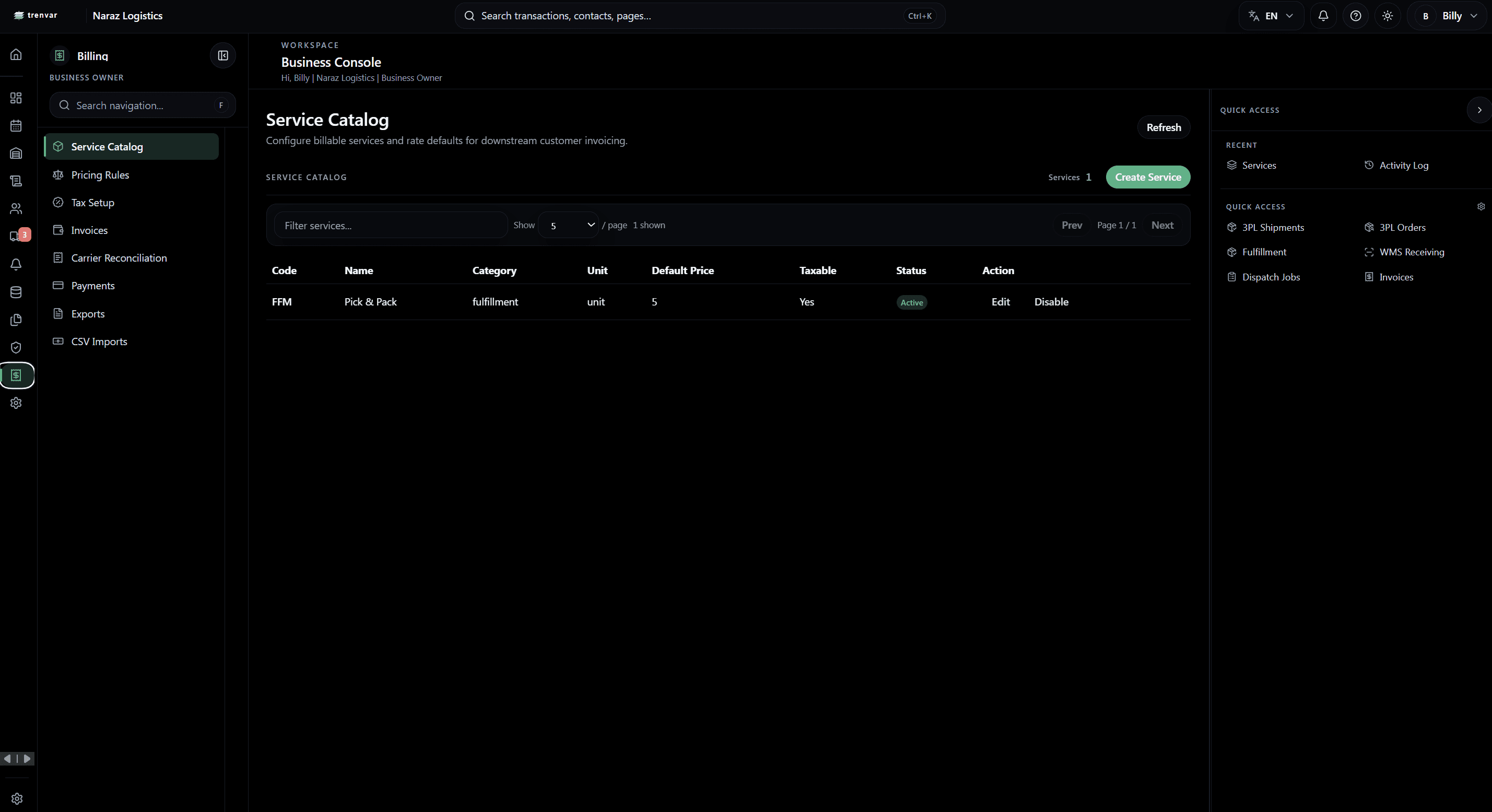
3PL billing is the financial engine of every 3PL business — and the most common operational failure mode.
The 3PLs that grow profitably are the ones whose billing scales linearly with operational activity. The 3PLs that stall or burn out are the ones whose finance team spends three days every month assembling invoices from spreadsheets.
The mental model
3PL billing as a continuous flow, not a month-end task
The fundamental shift that separates modern 3PL billing from legacy approaches.
Traditional 3PL billing treats the month as a discrete event: operators capture activity in the WMS, the finance team exports a CSV, the CSV gets pulled into Google Sheets, storage days are counted, handling events are tallied, and invoices go out three to five days into the next month. Customer disputes a charge — finance traces back to the spreadsheet, the spreadsheet is gone, and the customer wins the dispute by default.
Modern 3PL billing treats every billable event as it happens. The moment a pallet is received, a storage accrual line is born. The moment an order is picked, a handling charge accrues. The moment a label is purchased, the carrier cost is reconciled against the customer's billing line. There is no month-end reconciliation cycle because there is no manual reconciliation — the accrual is continuous, the audit trail is intact, and customer disputes resolve by pointing at the operational record.
This guide walks through what continuous, event-backed 3PL billing looks like in practice — and how to evaluate whether your current billing approach is holding your 3PL back.
The four pillars
What modern 3PL billing actually includes
Four operational areas that together make 3PL billing work at scale.
Per-client rate cards
Each customer has its own rate structure — storage rates, handling fees, special-service surcharges. Rate cards support tiered storage, promo overlays, and effective-date changes. Without per-client rate cards, you cannot bill mixed client books accurately.
Event-backed accrual
Every billable event captured at the moment it happens — receiving, picking, packing, shipping, storage day. Accruals flow into the customer's billing ledger in real time. No month-end recalculation.
Carrier reconciliation
Carrier invoices arrive with line items that may or may not match your shipment records. Modern 3PL billing includes automated reconciliation, variance surfacing, and chargeback queueing — the work that costs ops days every month.
Invoice generation + accounting sync
Approved charges flow into invoice runs with PDF generation, customer delivery, and clean export to accounting tools (QuickBooks, NetSuite, etc.). The customer-facing portal shows invoice status and payment state.
Anti-patterns
Three billing approaches that look fine until they break
Common patterns that work at five clients but fall apart at twenty.
Anti-pattern
The Google Sheet of Truth
Storage days, handling counts, and customer rate cards all live in a Google Sheet maintained by one finance person. Works at small scale; becomes a bus factor risk and a reconciliation nightmare past 10 clients.
Anti-pattern
Estimate-then-true-up
Send invoices based on monthly estimates, then adjust at quarter-end when actual data comes in. Cash flow goes haywire, customer disputes pile up, and your finance team becomes a reconciliation team.
Anti-pattern
WMS-and-spreadsheet hybrid
WMS exports operational data; finance recreates billing logic in spreadsheets every month. Inevitable drift between WMS-state and billing-state; auditability is zero; new client onboarding requires duplicating the spreadsheet logic.
Supporting articles
Seven deep-dives on specific billing questions
Each article tackles a specific operational question. Read in any order.
How 3PL Billing Works
Storage, handling, and shipment charges explained for new 3PL operators.
5 min read
Rate Card Setup
How to structure per-client pricing that scales without billing disputes.
7 min read
Reconciliation at Scale
Why month-end manual billing breaks once you cross a certain client count.
6 min read
Event-Based vs Estimate-Based Billing
The real difference between accrual-on-event and estimate-at-month-end billing.
5 min read
Client Invoicing Workflow
From approved charges to sent invoices to accounting sync.
6 min read
Carrier Invoice Reconciliation
Recovering margin lost to carrier invoice variances and chargebacks.
7 min read
QuickBooks Integration
What to look for in a 3PL billing system's QuickBooks integration.
5 min read
Putting it together
If you only do three things
The highest-leverage moves for any 3PL revisiting its billing approach.
- 1Move storage accrual to a daily event. Storage charges should accrue every day a customer's pallet sits in your warehouse — not be calculated in a spreadsheet at month-end. This single change eliminates the most common source of customer billing disputes.
- 2Implement per-client rate cards. Even if you only have two clients today, structuring rate cards per-client now prevents the painful migration when you grow to ten. Treat the rate card as a first-class data object, not as columns in a spreadsheet.
- 3Automate carrier invoice reconciliation. The single most under-leveraged source of 3PL margin recovery. Manual carrier reconciliation costs days and misses chargebacks worth thousands of dollars per month.
Want a 30-minute review of your billing setup?
Bring your current rate card structure and a sample customer invoice. We will walk through what continuous event-backed billing would look like on your operation.
No credit card required · Go live in under 48 hours